THE BUSINESS / EXPLAINER
Product placement in film and TV
The money, the immersion, and everything in between
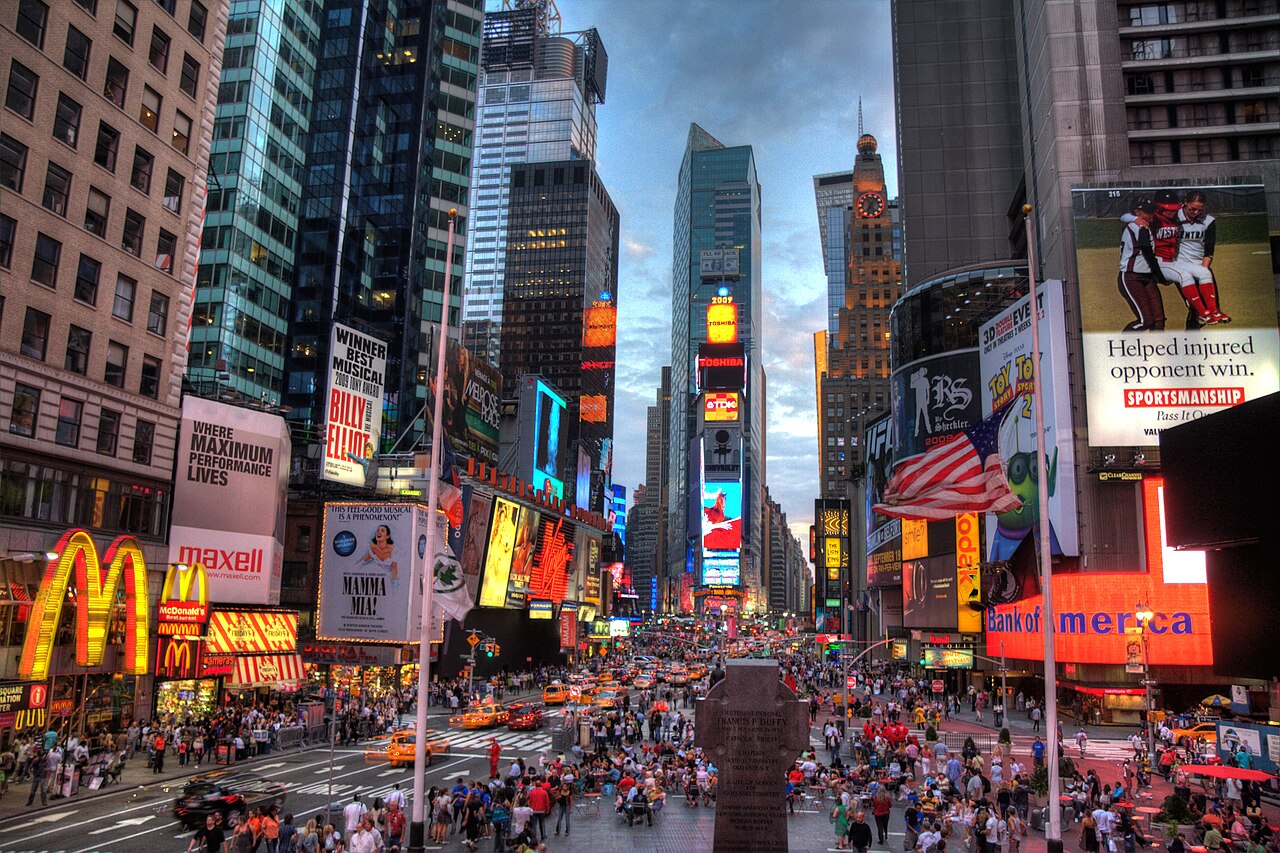
Times Square, New York. Street advertising, not an on-screen product placement.
A crime drama stops for a sandwich. In Hawaii Five-0, a food-truck owner talks up Subway: they make it however you want it; it is "serious culinary fusion." The character sounds less like a person eating lunch than someone delivering a pitch.
Jack and Jill makes Dunkin' Donuts part of the plot. Adam Sandler's character, a commercial director, risks losing the client unless he recruits Al Pacino for an ad. A contemporary Time review singled it out as the film's most egregious placement, ahead of a conspicuous Royal Caribbean cruise. The joke acknowledges the absurdity of the endorsement while delivering it anyway.
In Transformers: Age of Extinction, a Bud Light truck is wrecked during an action sequence; Mark Wahlberg's character picks up a bottle and drinks. A Houston Press reviewer reported that the calculated moment drew a knowing laugh. The brand has pulled attention from the battle to the deal behind the shot.
These older examples do not argue against partnerships. They show what obvious placement can cost: viewers briefly leave the world they were trying to enter. The question is how much a brand can bring to a production without asking a scene to stop being a scene.
An old idea, a larger market
Product placement did not begin with streaming. In E.T., Reese's Pieces help a boy reach an alien visitor.
Hershey's archive says Universal had chosen the candy and invited the company to promote the film. Hershey committed about $1 million to marketing it in exchange for exclusive confectionery promotional rights. That was promotional spending, not evidence of a $1 million fee paid to the studio for the appearance.
The market has grown. Research firm PQ Media estimated worldwide product-placement spending at $29.63 billion in 2023, up 12.3% from the previous year. It projected $32.98 billion for 2024, which was a forecast, not a measured result. Television accounted for 70.1% of its 2023 estimate; film accounted for 11.9%. The figures cover far more than scripted film and TV, including digital media, games and music. They show growth in the broader placement business, not that every screen story now contains more brands.
What the money pays for A recognisable product on screen is not necessarily a paid ad.
Variety describes three routes: a brand pays for a negotiated appearance; it supplies an item without guaranteed screen time; or a production writes in a product without the company's knowledge. A UTA executive estimated that the third route accounts for most appearances, but that is an industry estimate rather than a public census. Free supplies can save a production money. A fee or a larger partnership can support filming or a release campaign.
F1 shows how large a deal can become. Sponsors appeared on the cars and uniforms of its fictional racing team.
Forbes estimated that sponsorships brought in at least $40 million, against a reported production cost that could be as high as $300 million. Neither figure is a disclosed final account, and box office alone would not establish profit. The money can still matter: a producer interviewed by Forbes said deals may let filmmakers spend placement proceeds on production. In a sport whose real cars are covered with logos, those sponsors also help make a fictional team look convincing.
TheWrap reports that brand-backed studios and other partners have sought to fund projects while asking for input on scripts, casting or locations. That can offer another path when conventional financing is scarce. It also means the producer needs to know which creative decisions the money touches. Beyond the shoot, a partner can promote a release to its customers. Hershey's E.T. tie-in was one early example; the value of promotional support in any particular deal still has to be shown, not assumed.
A believable object, or an unskippable ad?
Brand names can be part of a credible setting.
Variety reports that The Bear put a Coke Zero beside Sydney during a quiet conversation with her father as part of a paid partnership. The scene remains about the people at the table, rather than turning into dialogue about the drink. Eleven's Eggo habit in Stranger Things, by contrast, arose without a deal, according to Variety. A real product can be a character detail without being paid placement.
But if viewers skip commercials or pay for an ad-free tier, an integrated brand follows them into the programme.
Marketplace reports that ad-skipping and tighter production budgets are among the forces drawing marketers toward placement. The benefit to a production is also the source of the audience's concern: it may be harder to tell whether an object serves the story or a sponsor. When a character starts listing a product's features, or the camera waits for a label after the action has moved on, the world can begin to feel less believable.
There are boundaries beyond taste.
Ofcom's rules for UK television broadcasters require independent editorial control, bar undue prominence and promotional references, and require disclosure signalling for certain programmes. Those rules are not a global rule for all theatrical films or streaming titles. They do show that the distinction between a fictional world and undisclosed advertising has practical consequences.
A published meta-analysis of brand placements found strong effects on memory of a placement, but smaller effects on attitudes and purchase intentions or choices. Connections to the plot were associated with stronger results; prominence improved recall without a corresponding clear gain in persuasion. The study does not measure immersion in any particular film, but it complicates the assumption that a bigger logo is always better marketing.
The stakes can extend beyond individual products.
Space Jam: A New Legacy sends LeBron James through Warner Bros. properties inside its digital universe.
The Atlantic argued that the film plays like a promotion for the studio's catalogue and HBO Max. It is cross-promotion rather than a drink on a table, but it poses the same question: how much should a story bend to display what its owner wants to sell?
The deal and the scene
The answer changes with the project. Sponsors are ordinary visual language in F1. A soft drink can plausibly sit on a kitchen table. A detective enthusiastically reviewing a sandwich is harder to accept. The presence of a logo alone cannot tell viewers whether anyone paid for it, whether it helped finance production, or whether it damaged the scene.
Placement can save costs, bring in funding and give a partner a reason to promote a release. Those benefits may help a film get made or give it a stronger launch. An obtrusive placement may draw attention to the transaction at the moment an audience wants to believe in the story. Both effects can be true. If a brand partnership is a way to finance a film, why not? The money and the scene each deserve care.
Sources Eater: Hawaii Five-0 Subway scene ↗Time: Jack and Jill review ↗Houston Press: Transformers placement ↗Variety: paid, supplied and organic placements ↗Forbes: F1 sponsorship estimate ↗TheWrap: brands and production ↗Marketplace: unskippable ads ↗The Atlantic: Space Jam review ↗Hershey Community Archives: E.T. partnership ↗PQ Media estimate via PRWeb ↗Ofcom: Section 9 commercial references ↗Journal of Research in Marketing: meta-analysis ↗